
Rethinking Plastic Surgery Consulting, Why Operational Expertise Drives Practice Growth
There’s a quiet assumption in our industry that the only way to understand plastic surgery practices is to have spent decades inside one. I don’t agree.
And more importantly, I don’t think the most successful practices do either.
As a plastic surgery consultant, my background started in sales and urgent care operations, fast-paced, high-volume environments where inefficiency shows up quickly and gets expensive even faster. That experience didn’t pull me away from plastic surgery consulting, it prepared me for it in ways that directly impact plastic surgery practice growth.
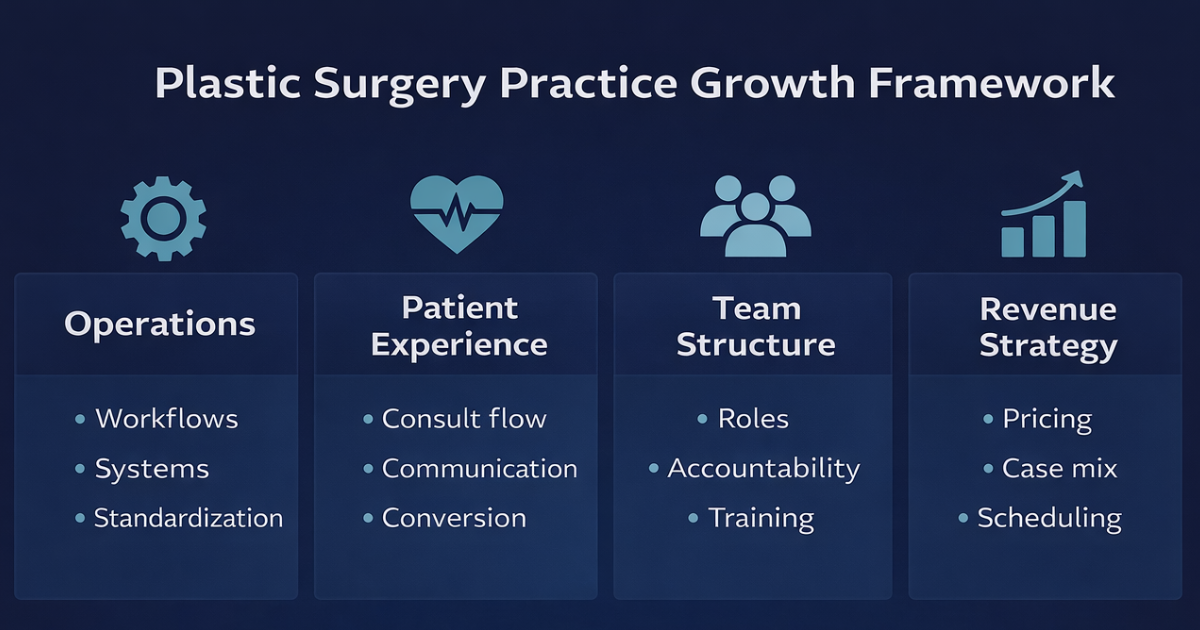
Growth doesn’t happen by accident, it’s built through operations, structure, and intentional patient experience.
What Strong Operations Look Like in Plastic Surgery Practice Management
Urgent care is operationally unforgiving. You don’t have the luxury of disorganization, unclear roles, or inconsistent processes.
That environment builds a skill set that translates seamlessly into plastic surgery practice management and practice management consulting.
Project Management That Drives Plastic Surgery Practice Growth
In urgent care, opening a new location or rolling out a new service line isn’t theoretical, it’s timeline-driven, resource-constrained, and highly visible.
You learn how to:
Build realistic timelines
Coordinate across clinical and administrative teams
Identify bottlenecks before they become problems
Execute, not just plan
That same discipline is exactly what plastic surgery consultants bring to practices that are:
Launching a new provider
Expanding into nonsurgical services
Opening an ASC or new location
Reworking consult flow or patient experience
Ideas are easy. Execution is where most practices stall.
Pre-Opening Planning for Plastic Surgery Startups and Expansion
One of the biggest gaps I see in plastic surgery practice consulting is not vision, it’s sequencing.
Urgent care forces you to think through:
Staffing models before day one
Patient flow before the first patient walks in
Systems before volume increases
Contingencies before things go wrong
That same level of planning is critical in:
Plastic surgery startup consulting
Hospital-based program launches
Adding providers or service lines
Growth without structure doesn’t scale, it strains.
Streamlined Processes Improve Patient Experience and Revenue
In urgent care, patient experience is built on efficiency and clarity.
That translates directly into plastic surgery, where the experience is even more important.
Streamlined processes lead to:
Faster consult-to-surgery conversion
Stronger patient confidence
Fewer dropped handoffs between team members
A more polished, high-end patient journey
This is where plastic surgery practice operations directly impact revenue. The practices that feel elevated are almost always operationally strong behind the scenes.
Why Standardization Is Essential in Plastic Surgery Practice Operations
One of the biggest misconceptions in plastic surgery practice management consulting is that standardization takes away from personalization.
It actually enables it.
Standardization Builds Consistency and Trust
When processes are standardized:
Teams operate more efficiently
Patients receive consistent communication
Errors and variability decrease
This creates the foundation for a strong plastic surgery practice strategy, where personalization becomes intentional, not reactive.
Scalable Systems Are the Foundation of Growth
If a practice wants to:
Add providers
Increase surgical volume
Expand into medspa services
Improve profitability
There has to be a repeatable system.
You can’t scale exceptions.
This is where business consulting services for plastic surgery practices become critical.
The Value of a Plastic Surgery Consultant with a Diverse Background
There’s value in deep specialty experience.
But there’s also value in bringing in perspectives from outside the traditional path.
Healthcare operations, at their core, are not specialty-specific. The fundamentals are the same:
Patient flow
Staffing models
Revenue cycle
Process design
Team accountability
What changes is how they’re applied.
Identifying Gaps Faster Through Cross-Industry Experience
Working across different healthcare models allows a plastic surgery consultant to:
Identify inefficiencies faster
Recognize patterns others may overlook
Apply proven systems in new ways
Sometimes the best solutions already exist, they just haven’t been applied to plastic surgery yet.
Bridging Strategy and Execution in Plastic Surgery Consulting
Plastic surgery practices don’t just need ideas.
They need:
Clear workflows
Defined roles
Accountability systems
Measurable outcomes
That’s the difference between consulting for plastic surgery practices and actually driving results.
Because growth doesn’t come from knowing the industry longer, it comes from building systems that work.
The Future of Plastic Surgery Practice Growth Is Operational Excellence
The most successful practices are not just clinically excellent. They are operationally disciplined.
They:
Invest in systems and structure
Prioritize patient experience intentionally
Focus on scalable growth
Utilize plastic surgery consulting services strategically
That’s not unique to one specialty. That’s what strong businesses look like.
And the sooner we expand the definition of what makes a great plastic surgery consultant, the faster practices will grow.