
AI Consulting for Plastic Surgery Practices
Practical AI strategies for plastic surgery practices focused on operations, patient experience, staffing, reporting, and decision making.
AI Is Not a Strategy
Many practices are experimenting with AI tools, but few have a clear plan for how those tools fit into their operations.
The result is often more confusion than efficiency.
PS² Practice Management helps plastic surgery practices identify where artificial intelligence can support existing workflows, reduce administrative burden, improve consistency, and provide better visibility into performance. The goal is not to replace people. The goal is to help your team work more effectively.
How Plastic Surgery Practices Can Use AI
-
AI can help practices organize, summarize, and improve internal processes.
Examples include:
SOP libraries
Staff training materials
Onboarding resources
Policy documentation
Internal knowledge bases
When paired with well documented processes, AI can help team members quickly find answers and follow established workflows.
-
Many practices collect data but struggle to turn it into actionable information.
AI can assist with:
KPI summaries
Trend identification
Monthly reporting
Operational dashboards
Meeting preparation
This allows leadership teams to spend less time gathering information and more time making decisions.
-
AI can help support consistency throughout the consult process.
Examples include:
Consult preparation checklists
Follow up templates
Objection handling resources
Conversation summaries
Pipeline reporting assistance
The goal is not to automate patient relationships. The goal is to help coordinators stay organized and focused.
-
AI can be used to create:
Training guides
Skills assessments
Coaching resources
Role specific learning materials
Meeting summaries
This can help practices improve onboarding and support ongoing team development.
-
Practice leaders can use AI to support:
Strategic planning
Process mapping
Workflow analysis
Capacity planning
Meeting facilitation
When combined with accurate practice data, AI can help leaders evaluate opportunities and identify operational bottlenecks.
What PS² Does and Doesn't Do
AI works best when it supports strong systems, not when it attempts to replace them.
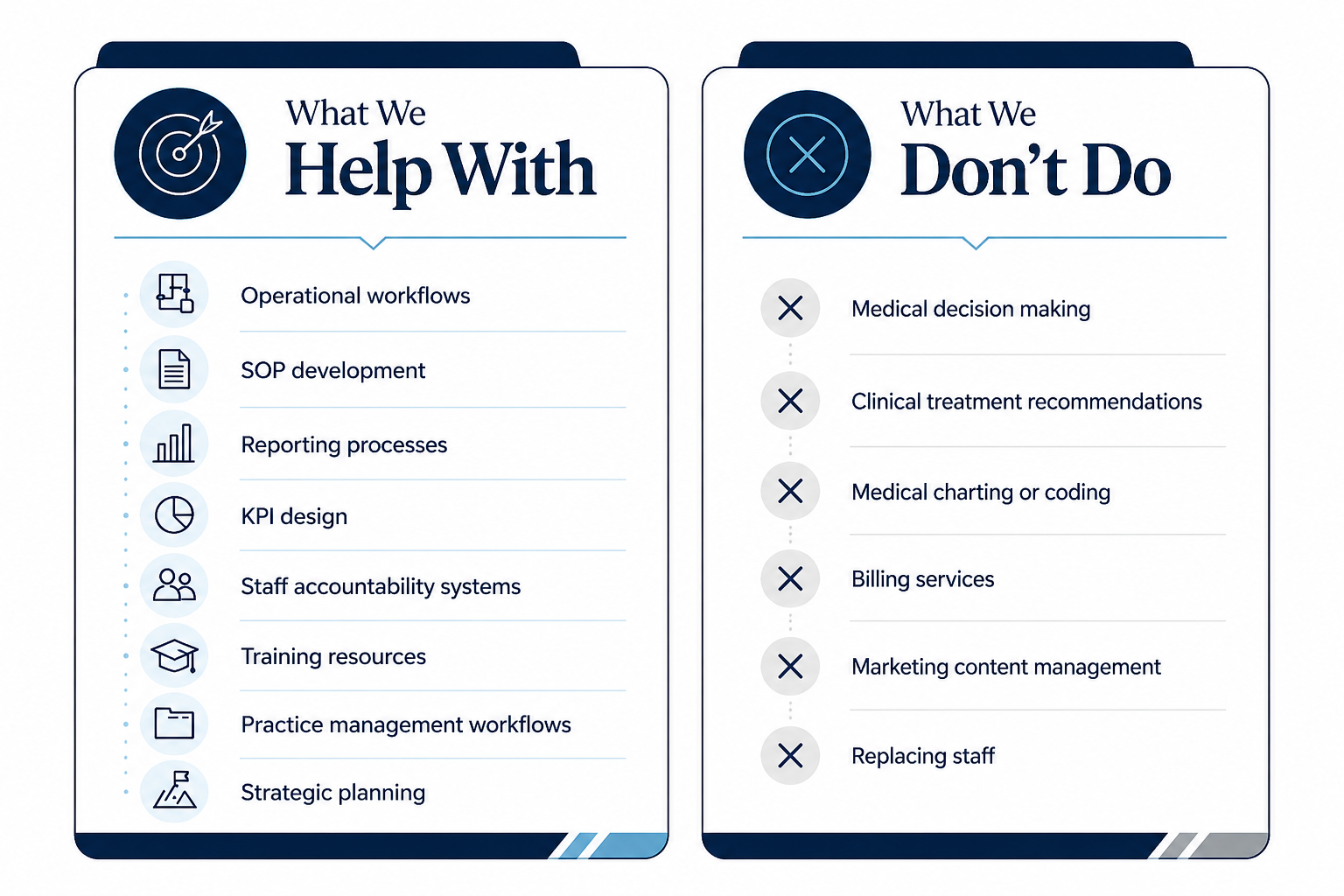
Our Approach
Before recommending AI tools, we focus on understanding how your practice operates today.
If a process is unclear, inconsistent, or poorly documented, introducing AI often creates more problems than it solves.
PS² helps practices establish the structure, accountability, and workflows needed to make AI useful. Once those foundations are in place, we can help identify practical opportunities where AI may improve efficiency and visibility.
AI In Plastic Surgery Frequently Asked Questions
-
Not necessarily. Many practices can achieve meaningful improvements simply by refining processes and creating better accountability. AI becomes more valuable when strong operational systems already exist.
-
No. The most successful implementations use AI to reduce administrative work, improve consistency, and provide faster access to information, allowing staff to focus on higher value responsibilities.
-
Recommendations depend on your goals, workflows, and existing technology. PS2 focuses on practical applications rather than chasing the newest tools.
-
AI can support reporting, tracking, training, and process consistency. However, conversion ultimately depends on the patient experience, team performance, and practice systems.
Curious How AI Could Support Your Practice?
AI is most effective when paired with strong operational systems.
Schedule a conversation with PS² to explore where AI may fit within your practice's workflows, reporting processes, and long term growth strategy.